
Call it fate, call it something in the ether, or call it a sign of changing times, but word has reached me of a hopscotch game that will put ten-year-old Lilly Allen’s efforts to shame (not that we’re being competitive). Residents of Seattle are organising a hopscotch trail that is set to go for nearly 2 miles across the Central District – and it’s happening in a couple of weeks!



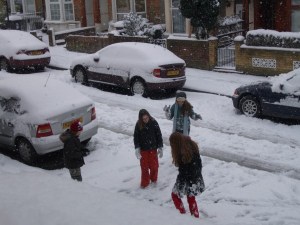 “When it snows, children take over the city: they sleigh, throw snowballs, make snowmen and are more visible than ever. But what a city needs for its children has to be more durable than snow.”
 On my visit to Moscow last week, I witnessed an intriguing sight as I was crossing a bridge near the city centre. A little girl and her mother were walking towards me. As they went past, the girl stooped down to make a snowball, and then she threw it playfully towards her mother. Not very noteworthy, you may think – except that it was minus 6 degrees Centigrade, with a biting wind and eight lanes of Moscow traffic roaring by just metres away from us. You could not have asked for a clearer example of children’s appetite for play, regardless of their circumstances. So how well does Russia’s capital satisfy that appetite – how child-friendly is it?
About Rethinking Childhood
This website is managed by Tim Gill, an independent scholar and global advocate for children’s play and mobility. His work embraces writing, research, consultancy and public speaking.
-
Join 1,430 other subscribers
Search this website
-
Recent posts
- Upcoming events in Australia
- Missed the launch events for ‘Urban Playground’? Watch again and read more here
- Announcing 2 launch events for ‘Urban Playground’
- A reminder of the significance of play in lockdown
- My new book ‘Urban Playground’: Sneak peek and seasonal discounted price
- A vibrant young city is building better neighbourhoods for early childhood. Can it sustain and broaden its impact?
- Covid-19 and children: what does the science tell us, and what does this mean as the lockdown is eased?
- Academics highlight children’s need for street play during lockdown
Tim’s twitter feed
Tweets by timrgillBrowse by category
Browse by tags
adventure Adventure playground ASTM Australia Bernard van Leer Foundation campaign Canada car dependence child-friendly cities child-friendly urban planning child development childhood children's independent mobility children's moral development child safety community deep play design early childhood early years education evidence Forest school freedom free range kids Freiburg Funding health Health and Safety Executive HSE London media Media coverage mobility National Trust nature nature deficit disorder nature play neighbourhood Netherlands outdoor education outdoor learning outdoor play parenting planning policy play Play England playground playground safety playing out Play Safety Forum play space playwork policy public health public policy public space research Risk risk assessment risk benefit assessment road closure Rotterdam schools standards street play streets transport urban design urbanism Urban planning USA video Walthamstow Winston Churchill Memorial TrustFacebook
Website Stats
- 1,185,356 page views since July '11
 Rethinking Childhood